
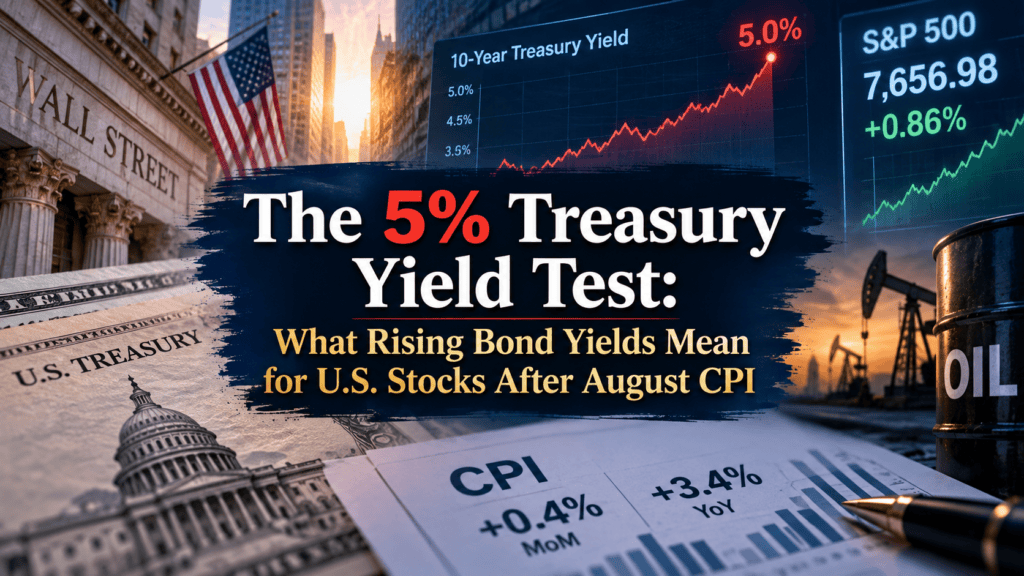
Wall Street is heading into a pivotal week with three forces pulling markets in different directions.
Inflation is still running well above the Federal Reserve’s 2% goal. Oil prices have climbed sharply. And the 10-year Treasury yield is sitting just below the psychologically important 5% level.
At first glance, that combination sounds uncomfortable for stocks.
Yet the market has not behaved like it is heading for an immediate breakdown. Instead, investors have continued to buy the dips, even as bond yields and energy prices move higher.
That leaves investors with a more interesting question than simply asking whether the Federal Reserve will change interest rates:
How much higher can Treasury yields go before they begin to seriously change the way investors value U.S. stocks?
The answer may depend less on the 5% number itself and more on what is driving yields toward it.
August CPI Keeps the Inflation Debate Alive
The latest Consumer Price Index report gave investors plenty to think about.
According to the U.S. Bureau of Labor Statistics, headline CPI increased 0.4% in August on a seasonally adjusted basis. Over the 12 months through August, consumer prices were up 3.4%.
Core CPI, which excludes food and energy, increased 0.3% in August and 2.4% over the past year.
The details are particularly important.
Gasoline prices increased 3.9% during August and accounted for more than one-third of the monthly increase in headline CPI. The broader energy index rose 2.1% during the month and was up 16.3% over the previous year.
At the same time, shelter prices increased 0.3% in August, while the index for services excluding energy services also continued to move higher.
In other words, this was not simply an oil story.
Energy clearly played a major role, but underlying inflation has not disappeared either.
That distinction matters because the Federal Reserve has to determine whether higher inflation is likely to fade or become more persistent.
For traders, the full August CPI release from the U.S. Bureau of Labor Statistics is worth reading beyond the headline number.
The 10-Year Treasury Yield Is Becoming the Bigger Market Variable
The Federal Reserve directly controls short-term policy rates, but it does not set the 10-year Treasury yield.
Instead, the 10-year yield reflects a much broader combination of factors, including expectations for future interest rates, inflation, economic growth, Treasury supply and demand, and investor risk preferences.
That is why the recent move in long-term yields deserves attention.
The 10-year Treasury yield finished September 11 at roughly 4.96%, according to market data tracking Treasury yields. That puts it very close to 5%.
The important point, however, is not whether the yield briefly crosses 5%.
The bigger question is whether it can stay around or above that level.
A temporary move can be absorbed by markets.
A persistent rise is different.
If investors begin to believe that 5% or higher is the new normal for long-term Treasury yields, the required return on stocks changes as well.
Why Higher Treasury Yields Can Pressure Stock Valuations
Think about a stock in very simple terms.
Investors are paying today for profits they expect a company to generate in the future.
When the return available from relatively low-risk government bonds rises, investors generally demand more compensation for taking equity risk.
That creates a valuation problem for some stocks.
Consider two companies.
Company A generates substantial cash flow today.
Company B is expected to generate much larger profits five or ten years from now.
If long-term interest rates rise sharply, Company B can face greater valuation pressure because more of its perceived value depends on distant cash flows.
That does not mean growth stocks automatically fall when Treasury yields rise.
Instead, it means the market becomes less willing to pay extremely high prices for future growth unless the expected growth rate is strong enough to justify the valuation.
This is why the interaction between bond yields and earnings expectations is so important.
The Market Has Not Given Up on Earnings
There is another side to the story.
If rising Treasury yields were the only factor that mattered, the stock market would be much easier to predict.
It isn’t.
Companies can grow their earnings, improve margins, increase productivity and generate more cash. When that happens, stronger fundamentals can offset some of the valuation pressure created by higher rates.
That helps explain why stocks can remain resilient even when bond yields rise.
The market is effectively asking:
Are higher rates happening because the economy is strong, or because inflation is becoming more difficult to control?
Those are two very different environments.
If yields rise because economic growth is stronger than expected, investors may tolerate the move.
If yields rise because inflation expectations are becoming less stable, the reaction can be much more difficult for equities.
Oil Has Suddenly Become a Critical Part of the Story
The inflation picture becomes even more complicated when energy prices are moving sharply higher.
The U.S. Energy Information Administration reported that WTI crude settled at $103.57 per barrel on September 10, while Brent settled at $120.98. The U.S. average regular gasoline price was $4.30 per gallon.
Those are large numbers, and they matter because energy works its way through the economy.
Higher crude prices can increase transportation costs.
They can raise production expenses for energy-intensive businesses.
They can push gasoline prices higher for consumers.
And, eventually, they can influence inflation expectations.
That creates a feedback loop that traders need to watch.
Oil rises → inflation expectations rise → Treasury yields rise → financial conditions tighten → equity valuations come under pressure.
Of course, the chain does not always play out this neatly. Companies can absorb higher costs, consumers can change spending patterns, and oil prices can reverse quickly.
Nevertheless, the relationship is important enough that crude oil is now part of the broader Treasury-yield story.
The latest official energy-market figures are available from the U.S. Energy Information Administration.
The Fed’s September Meeting Comes at a Difficult Moment
Timing makes the current setup even more interesting.
The Federal Open Market Committee is scheduled to meet September 15–16.
The Federal Reserve’s July meeting ended with the target federal funds range unchanged, although three policymakers preferred a 25-basis-point increase.
Since then, investors have received another inflation report and have watched energy prices climb sharply.
That means the September meeting will be about more than the immediate rate decision.
Markets will be listening carefully to how policymakers describe inflation, economic growth and future policy.
A decision that is already expected by markets may produce relatively little reaction.
The more important move could come from the Fed’s communication about what happens next.
Three Possible Market Setups
The next stage of the market can be thought about through three broad scenarios.
Scenario 1: Yields stabilize below 5%
This would probably be the easiest environment for stocks to digest.
Suppose the 10-year yield moves around 4.8% to 5.0% but stops climbing rapidly.
In that situation, investors have time to adjust.
If corporate earnings continue improving, the market may be able to absorb the higher discount rate.
The key word here is stability.
Markets generally handle a high level of interest rates better when investors know where rates are likely to settle.
Scenario 2: The 10-year yield moves decisively above 5%
This would create a bigger valuation test.
A move above 5% would not automatically mean stocks are heading into a bear market.
However, it could force investors to reassess how much they are willing to pay for future earnings.
The impact would probably be greatest if yields rise at the same time that earnings expectations weaken.
That combination would create pressure from both directions.
The discount rate would be rising while the expected cash flows used to justify stock valuations would be falling.
Scenario 3: Oil prices retreat and yields follow
This would provide the most obvious relief.
If energy prices decline, inflation expectations could become less threatening. That could take some pressure off the Treasury market.
Lower yields, in turn, could make equity valuations easier to support.
However, this scenario depends heavily on what happens in the energy market and whether the recent oil-price surge proves temporary or persistent.
The Most Important Relationship May Be Rates Versus Earnings
There is a useful framework investors can use to interpret the next few weeks.
Imagine two variables:
Treasury yields: rising or stable
Earnings expectations: improving or deteriorating
That creates four broad market environments.
| Environment | Treasury Yields | Earnings Outlook | Potential Market Effect |
|---|---|---|---|
| A | Stable | Improving | Generally supportive |
| B | Rising | Improving | Mixed |
| C | Stable | Deteriorating | Growth concerns |
| D | Rising | Deteriorating | Most challenging |
Right now, the market appears closer to Environment B than Environment D.
Yields are rising, but that does not yet mean investors have abandoned the earnings story.
That distinction is crucial.
The biggest warning sign would be a transition from B to D: yields continuing higher while earnings estimates begin moving lower.
That is when the valuation argument becomes much harder for stocks to defend.
What Traders Should Watch This Week
The Federal Reserve decision will receive the headlines, but several other indicators may provide more useful information.
Watch the 10-year yield after the Fed speaks
The initial market reaction can be noisy.
Instead, watch where the 10-year yield settles after investors have had time to digest the Fed’s message.
A falling yield could suggest that the bond market had already priced in much of the inflation risk.
A sharp move higher could indicate that investors expect tighter financial conditions to persist.
Watch oil
Oil has become an important inflation indicator.
If crude remains above $100 for an extended period, the inflation discussion becomes more complicated.
If prices retreat significantly, some of the pressure could ease.
Watch market breadth
A rising S&P 500 does not necessarily mean the entire market is healthy.
If only a small group of mega-cap stocks is supporting the index while most stocks weaken, that tells a different story from a broad rally.
Market breadth can therefore help distinguish between genuine risk appetite and a narrow index-driven advance.
Watch earnings expectations
This may ultimately be the most important variable.
If earnings expectations remain strong, stocks may continue to absorb higher yields.
If analysts begin cutting earnings expectations while Treasury yields rise, the market could become considerably more fragile.
What Does a 5% Treasury Yield Actually Mean?
It is tempting to treat 5% as a magic number.
It isn’t.
There is nothing mathematically special about 5% that guarantees a particular stock-market outcome.
Instead, 5% matters because it represents a meaningful level of long-term borrowing costs and because investors naturally compare the return available from Treasury securities with the expected return from equities.
More importantly, the market cares about the direction and persistence of yields.
A 10-year yield that touches 5% for a few minutes is one thing.
A 10-year yield that remains above 5% for months is something else entirely.
The second situation would have a much greater influence on corporate financing costs, mortgage rates, valuation models and portfolio allocation decisions.
Why This Market Could Remain Volatile
The unusual feature of the current environment is that none of the major variables is moving in isolation.
Inflation remains elevated.
Oil prices are high.
Long-term Treasury yields are approaching 5%.
The Fed is meeting.
And, at the same time, investors still have strong expectations around corporate earnings and productivity.
That creates competing forces.
The bond market is saying that investors want more compensation for inflation, duration and fiscal risk.
The equity market is saying that corporate growth can still justify relatively high valuations.
Eventually, one side may prove stronger.
But there is no reason to assume that happens immediately.
The Bottom Line
The 5% level on the 10-year Treasury yield should not be treated as an automatic sell signal for U.S. stocks.
Instead, think of it as a market stress test.
If yields approach or move above 5% while corporate earnings remain strong, equities may demonstrate that earnings growth can offset some valuation pressure.
If yields rise while earnings expectations weaken, the situation becomes much more challenging.
And if oil prices continue pushing inflation higher at the same time, the Federal Reserve could face an even more difficult policy environment.
For investors and traders, therefore, the most useful question is not simply:
“Will the 10-year Treasury yield hit 5%?”
The better question is:
“What happens to yields, oil prices and earnings expectations after they get there?”
That combination will tell us far more about the market’s next phase than the 5% headline by itself.
Educational Disclaimer: This article is for informational and educational purposes only. It is not personalized investment, trading, tax or financial advice. Market conditions can change quickly, and historical relationships do not guarantee future results. Investors should conduct independent research and consider their own circumstances before making financial decisions.
Research the Market. Test the Strategy.
Explore U.S. market news, trading research, investing insights, historical backtests, and data-driven market analysis.
Explore BacktestCart →