
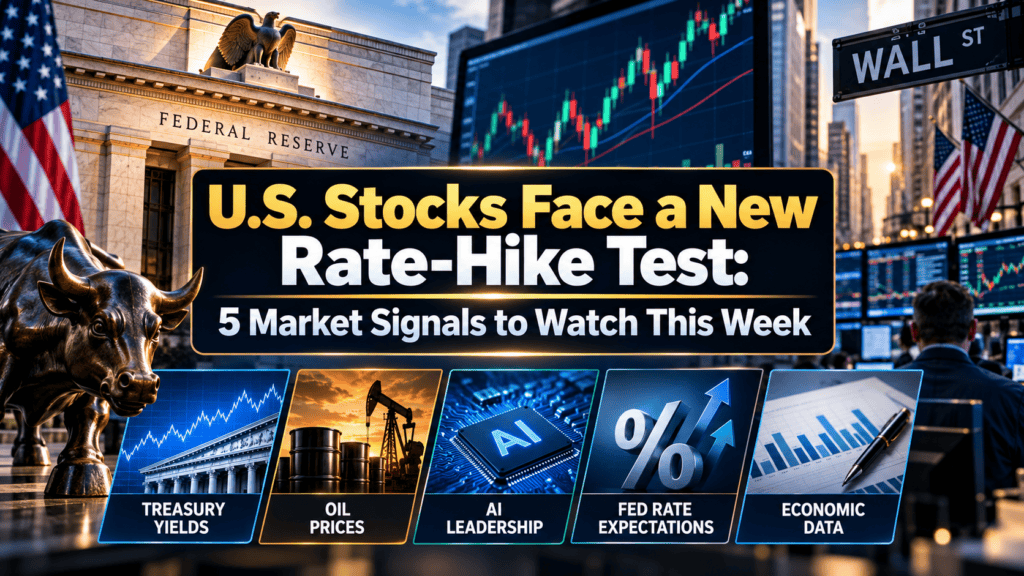
U.S. Stocks Enter a Different Market Environment
The U.S. stock market begins the week of September 21 with an unusual combination of forces.
Technology stocks are showing renewed strength. Oil prices are retreating from recent highs. Treasury yields have eased from the levels reached during the previous week’s inflation-driven volatility. At the same time, the Federal Reserve has just raised interest rates and signaled that additional tightening remains possible.
In Monday’s premarket trading, Dow futures were up 0.84%, S&P 500 futures were up 0.67%, and Nasdaq-100 futures were up 1.05%, according to Reuters. AI-related stocks were among the strongest areas, while a decline of more than 2% in crude prices helped reduce some pressure on inflation-sensitive assets.
That does not mean the market has entered a new one-directional trend.
Instead, investors are facing a market in which interest rates, inflation, energy prices, AI investment and economic growth are interacting more directly.
The next few sessions could therefore be less about the headline Fed decision and more about how markets process its consequences.
The Fed Has Changed the Policy Backdrop
On September 16, the Federal Open Market Committee voted unanimously to raise the federal funds target range by 25 basis points to 3.75%–4.00%.
The Fed said economic activity was expanding at a solid pace, domestic spending was resilient, productivity growth was strong and capital investment remained robust. It also said inflation remained elevated and that the policy move was intended to support a more timely return toward its 2% inflation objective.
The Fed’s September projections add another layer.
The median projection for the federal funds rate was 4.1% at the end of 2026, while the median unemployment-rate projection was 4.1%. The median PCE inflation projection for 2026 was 3.7%, with core PCE inflation projected at 3.4%.
These projections are not promises about future policy.
They are estimates from FOMC participants based on information available at the time.
For markets, however, they matter because they establish a reference point.
Investors now have to consider whether incoming inflation and growth data are consistent with the Fed’s current projections—or whether another repricing of rate expectations could occur.
Signal No. 1: Treasury Yields
Treasury yields remain one of the most important signals for interpreting U.S. equity-market behavior.
The reason is straightforward.
The federal funds rate directly affects short-term monetary conditions, while longer-term Treasury yields incorporate expectations about inflation, growth, monetary policy and demand for government debt.
After the September Fed meeting, the two-year Treasury yield became particularly important because it is closely linked to expectations for future Fed policy. Reuters reported that the two-year yield jumped to its highest level in more than two years immediately after the September decision.
By Monday morning, however, Treasury yields were retreating as oil prices declined and risk sentiment improved. Reuters reported that the 10-year Treasury yield had slipped below the 5% level in premarket trading.
For equity-market observers, the key question is not simply whether yields are high.
It is whether yields are rising or falling and why.
A decline in yields caused by softer inflation expectations can have a different market implication from a decline caused by deteriorating growth expectations.
Likewise, rising yields caused by stronger economic growth are not necessarily equivalent to rising yields caused by renewed inflation fears.
The underlying driver matters.
Signal No. 2: Oil Prices
Oil has become another major market variable.
Recent energy-price volatility has contributed to concerns about inflation because higher energy costs can feed into transportation, production and consumer prices.
That is why Monday’s decline in crude prices mattered.
Reuters reported that crude prices fell more than 2% and reached an 11-day low amid indications of progress in Middle East negotiations. The decline helped reduce pressure on Treasury yields and supported a more constructive premarket environment for equities.
The relationship can be viewed as a chain:
Oil ↓ → inflation pressure potentially eases → yields may ease → valuation pressure may decline.
But that is only a framework, not a guaranteed sequence.
Oil prices can also move because of supply disruptions, geopolitical developments, production decisions or changing global demand.
For stock-market analysis, therefore, the important signal is whether an oil-price move is temporary or represents a sustained change in the inflation outlook.
Signal No. 3: AI and Semiconductor Leadership
Technology and AI-related stocks remain an important driver of U.S. index performance.
Monday’s premarket session showed that clearly.
Reuters reported that Intel rose 5.7% in premarket trading, while Marvell, Meta and Dell also advanced. Accenture gained after announcing a partnership with Anthropic involving a $2 billion investment in AI evaluation.
This follows a difficult period for technology stocks.
Earlier in September, concerns about the pace and economics of AI spending had weighed on semiconductor and technology shares. The market subsequently began focusing again on continuing AI infrastructure investment.
This creates an important distinction for investors.
A strong AI stock-market move does not automatically mean every AI-related company will benefit equally.
The market may increasingly differentiate between:
- semiconductor manufacturers;
- networking companies;
- data-center infrastructure;
- cloud providers;
- software companies;
- AI model developers;
- companies using AI to improve productivity.
The investment story is therefore becoming broader than simply “AI stocks.”
For the overall market, sustained leadership from technology and semiconductor shares could continue to influence the Nasdaq and S&P 500.
But concentration is also worth monitoring.
If indexes rise mainly because a relatively small group of technology companies is advancing, broader market participation becomes an important secondary signal.
Signal No. 4: Expectations for Another Fed Hike
The September rate increase did not necessarily close the door on further tightening.
Reuters reported Monday that markets were pricing about a 50% chance of another rate hike in October, based on CME FedWatch data. That probability had been around 53.1% on September 17.
These probabilities can change quickly.
They should therefore be treated as market-implied expectations rather than predictions from the Federal Reserve.
The more important question is what happens to those expectations when new economic data arrives.
If inflation remains unexpectedly strong, expectations for additional tightening could rise.
If economic activity weakens materially while inflation pressures ease, expectations could move in the opposite direction.
This is why the market’s reaction to economic data may matter more than the absolute level of a single data release.
A number can be considered “good” for the economy but still produce a negative stock-market reaction if it causes investors to expect tighter monetary policy.
That is one of the defining characteristics of a rate-sensitive market.
Signal No. 5: The Economic Calendar
The coming economic calendar gives investors several opportunities to reassess the rate outlook.
The Bureau of Economic Analysis is scheduled to release Personal Income and Outlays for August 2026 on September 30. The report includes the PCE price indexes, which are closely followed because the PCE price index is the Federal Reserve’s preferred inflation measure.
The Bureau of Labor Statistics is scheduled to release the September Employment Situation on October 2.
The September CPI report is scheduled for October 14, followed by the September PPI report on October 15.
That sequence creates a potentially important period for markets.
Investors will be watching whether inflation remains elevated while employment remains relatively resilient.
The combination matters because it influences the Fed’s policy trade-off.
Why PCE Matters
The PCE price index measures changes in the prices of goods and services purchased by consumers in the United States.
The latest available BEA data before the August report showed the PCE price index up 3.7% from a year earlier in July.
The September 30 release will therefore be one of the next major opportunities for markets to assess whether inflation is moving closer to the Fed’s target or remaining stubbornly elevated.
Why Jobs Data Matters
The labor market is equally important.
The September Employment Situation will provide new information about employment growth, unemployment and wage-related conditions.
The Fed’s September projections placed the 2026 unemployment rate at 4.1%.
If labor-market conditions remain firm while inflation remains elevated, investors could continue to price a relatively restrictive monetary-policy environment.
If labor conditions weaken sharply, the interpretation could become more complicated.
The market would have to balance weaker growth against potentially lower inflation pressure.
Why the S&P 500’s Breadth Matters
Index performance alone does not tell the entire story.
The S&P 500 ended September 18 at 7,650.50, down 0.1% for the week. The Nasdaq gained 0.7%, while the Dow fell 1.7%. Reuters reported that technology was the strongest S&P 500 sector on Friday, while utilities were the weakest.
That divergence is worth watching.
A market in which technology continues to outperform while economically sensitive or defensive groups lag can behave very differently from a market where gains are broadly distributed.
One useful framework is to monitor:
Index direction + sector leadership + advancing/declining stocks + new highs/new lows.
This provides a broader picture than the headline index number.
What Could Change the Market Narrative?
The current market narrative is built around several assumptions:
- Inflation remains elevated.
- The Fed is willing to keep policy restrictive.
- Economic growth remains reasonably resilient.
- AI capital spending remains strong.
- Lower oil prices could reduce some inflation pressure.
- Markets may still price another rate increase.
Any major change to these assumptions could produce a different market reaction.
For example, a sharp rise in oil prices could put inflation concerns back at the center of trading.
A significant deterioration in employment could shift attention toward recession risk.
A stronger-than-expected economic report could support corporate earnings but simultaneously increase concerns about future Fed tightening.
And a renewed acceleration in AI spending could continue to support technology leadership even if broader market participation remains uneven.
The U.S.-China Meeting Is Another Market Variable
Global trade and technology policy could also receive attention this week.
Reuters reported that U.S. and Chinese officials concluded talks on Sunday and that a meeting between U.S. President Donald Trump and Chinese President Xi Jinping was expected on Thursday. Topics could include trade arrangements, the Iran conflict and AI regulation.
For investors, the relevant point is not to predict the outcome.
It is to recognize that developments involving the world’s two largest economies can affect expectations for:
- tariffs;
- semiconductor supply chains;
- technology investment;
- industrial companies;
- global trade;
- multinational earnings.
This makes trade headlines another potential source of volatility.
What Investors Should Watch Rather Than Predict
The current environment rewards observation more than headline chasing.
Five relationships deserve particular attention:
1. Stocks vs. Treasury Yields
Are stocks rising while yields fall, or are both rising?
2. Oil vs. Inflation Expectations
Is falling oil becoming a sustained trend or simply a short-term reversal?
3. AI Leadership vs. Market Breadth
Are technology stocks lifting the whole market or only a narrow group of indexes?
4. Economic Data vs. Fed Expectations
Does incoming data increase or decrease the probability of additional tightening?
5. Volatility vs. Direction
Is volatility declining as the market establishes a new trend, or is the market simply becoming temporarily quieter before another repricing?
These relationships can provide more useful information than trying to forecast a single index level.
Three Possible Market Scenarios
Scenario 1: Soft Landing Narrative Strengthens
If inflation gradually cools while economic growth and employment remain resilient, markets could continue to focus on earnings and productivity.
Technology and AI investment could remain important drivers.
This is a scenario, not a forecast.
Scenario 2: Inflation Remains Persistent
If inflation stays elevated and energy prices rise again, the market could become increasingly focused on the possibility of additional rate hikes.
Treasury yields would become an especially important signal.
Scenario 3: Growth Weakens
If employment and economic activity deteriorate materially, markets could shift their attention from inflation toward growth risk.
That could produce a different relationship between equities, bonds and interest-rate expectations.
The important point is that all three scenarios remain dependent on incoming data.
What This Means for the Rest of September
The rest of September is unlikely to be defined by the Fed decision alone.
Instead, markets will be digesting its implications while waiting for the next major inflation and employment reports.
For the week beginning September 21, the most visible themes are:
- technology and AI leadership;
- oil-price direction;
- Treasury yields;
- expectations for another Fed hike;
- global trade developments;
- upcoming economic data.
The September 30 PCE release and October 2 employment report will then become increasingly important reference points.
For market participants, this creates a simple framework:
Watch the data. Watch yields. Watch oil. Watch breadth. Then evaluate the market reaction.
The reaction itself often contains more information than the headline.
Conclusion
U.S. stocks are entering a new monetary-policy environment after the Federal Reserve raised its target federal funds range to 3.75%–4.00% on September 16.
The immediate market response has not been uniformly defensive.
Technology shares have shown renewed strength, oil prices have retreated, Treasury yields have eased from recent highs, and U.S. equity futures were higher ahead of Monday’s session.
But the rate-hike story is not finished.
The Fed’s September projections still show elevated inflation, while markets continue to consider the possibility of another increase.
That makes the next several weeks important for determining whether the current market reaction develops into a broader trend or another period of rapid repricing.
The most useful signals are therefore not simply whether the S&P 500 rises or falls.
Watch Treasury yields, oil, AI leadership, market breadth and economic data together.
That combination provides a more complete view of the forces currently driving U.S. markets.
FAQ
Did the Federal Reserve raise interest rates in September 2026?
Yes. On September 16, 2026, the FOMC unanimously raised the federal funds target range by 25 basis points to 3.75%–4.00%.
Could the Fed raise rates again in October 2026?
Market expectations indicated roughly a 50% probability of another hike in October on September 21, according to CME FedWatch data cited by Reuters. This probability can change as new economic information arrives.
Why are Treasury yields important for U.S. stocks?
Treasury yields reflect expectations around interest rates, inflation, growth and government borrowing. Changes in yields can influence equity valuations and investor positioning.
Why are oil prices important for the stock market?
Energy prices can influence inflation expectations and corporate costs. A sustained increase in oil prices can increase inflation concerns, while falling prices can reduce some of that pressure.
When is the next major PCE inflation report?
The BEA is scheduled to release August 2026 Personal Income and Outlays, including PCE inflation data, on September 30, 2026.
When is the next U.S. jobs report?
The September 2026 Employment Situation is scheduled for October 2, 2026, at 8:30 a.m. Eastern Time.
Financial & Educational Disclaimer
This article is for informational and educational purposes only and does not constitute investment, trading, financial, tax or legal advice. Market conditions can change rapidly, and historical observations or market scenarios do not guarantee future results. Investors and traders should conduct their own research and consider their individual circumstances, risk tolerance and objectives before making financial decisions.
Sources & Further Reading
- Federal Reserve — September 16, 2026 FOMC Statement
- Federal Reserve — September 2026 Economic Projections
- Reuters — Wall St set for higher open as AI stocks rise, oil slides
- Reuters — Tech leads Wall Street higher as oil eases and Treasury yields dip
- U.S. Bureau of Economic Analysis — Personal Income and Outlays Release Schedule
- U.S. Bureau of Labor Statistics — 2026 Release Schedule
- BEA — Personal Consumption Expenditures Price Index